
Crossing quality
Prefer marked crossings, signal-controlled intersections, pedestrian islands, bridges, or underpasses where available. A slightly longer route may be much easier.
Choose a safer crossing before taking the first step
Marked facilities, full attention, visible gaps, predictable movement, and routes matched to the group matter more than copying a confident stranger.
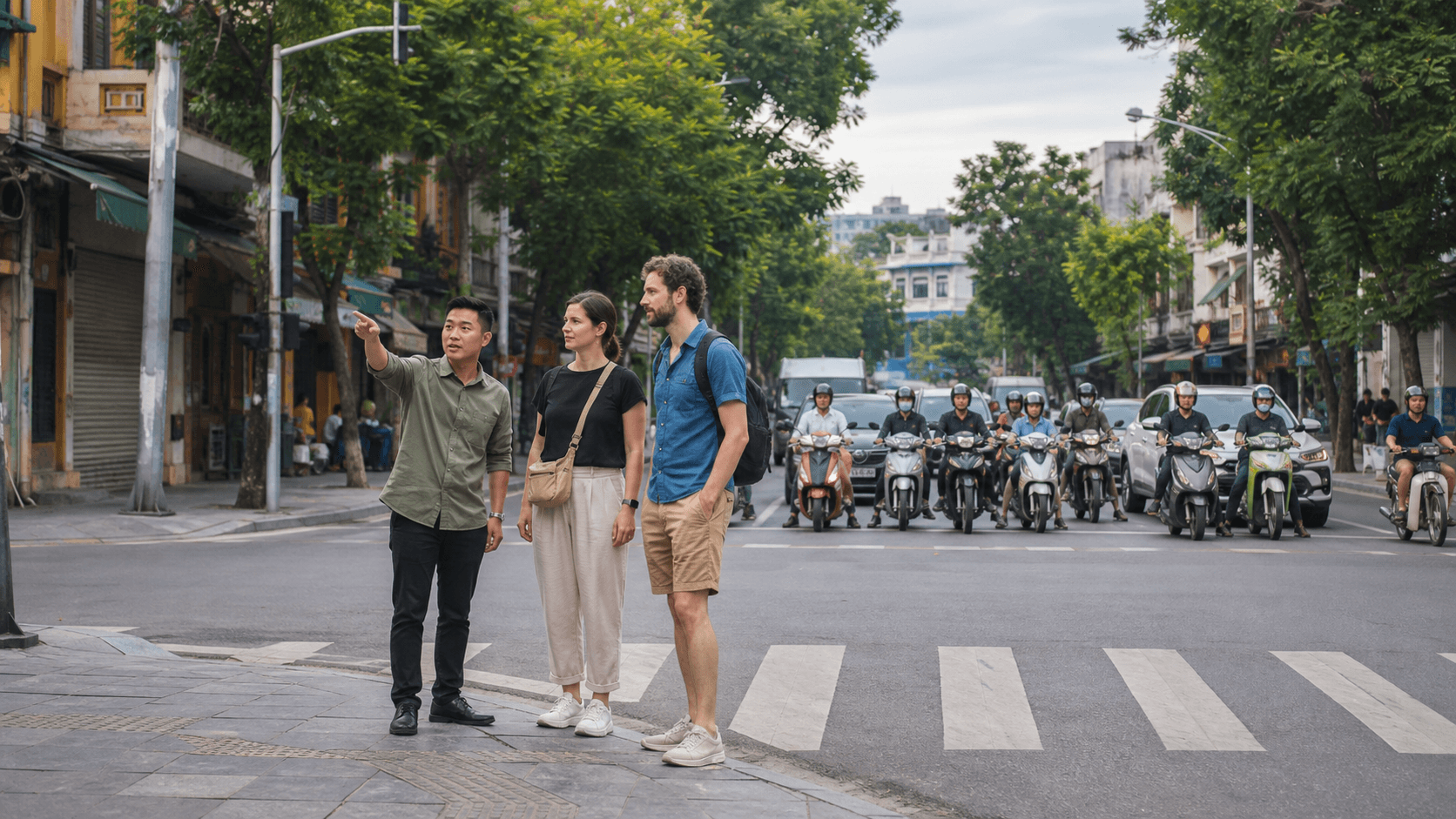
Busy movement can be fascinating to watch and difficult to navigate.
Vietnam Tourism describes Hanoi’s Old Quarter as rewarding to explore on foot while acknowledging its frenetic mix of shops, sidewalks, and motorbikes in the official neighborhood guide.
Online advice sometimes turns crossing into a simple trick. No gesture, pace, eye contact, or local imitation guarantees that every driver has seen you or will stop. Safer planning starts with the facility and route—not confidence alone.
A walkable distance can contain an unsuitable crossing.
Prefer marked crossings, signal-controlled intersections, pedestrian islands, bridges, or underpasses where available. A slightly longer route may be much easier.
At intersections and driveways, check for vehicles turning from every direction—including from behind—before and throughout the crossing.
A map may label a walkable street without showing steps, parked vehicles, vendors, construction, broken surfaces, drainage gaps, or sections without a usable footway.
More lanes, faster traffic, poor sight lines, and limited refuge increase complexity. Do not choose a crossing simply because it is the shortest line to the destination.
Rain, glare, darkness, crowds, school or work peaks, loading activity, and festival closures can change a familiar route.
Children, older adults, wheelchair users, low vision, hearing differences, balance, fatigue, luggage, and different walking speeds should determine the route.
The Vietnam hotel-location guide helps compare actual walking convenience, noise, pickup access, and daily transport rather than map distance alone.
It is a decision process, not a promise of safety.
Pause away from the traffic edge. Put the phone away, remove or pause audio, and keep children or companions together before assessing the road.
Use the designated facility when available. Check the landing point on the far side so the group does not finish among parked vehicles or an inaccessible curb.
Look and listen for vehicles, bicycles, motorbikes, buses, and turning traffic. Check again even when a pedestrian signal or another person appears to give permission.
Do not step out because a stranger, influencer, or driver waves. Confirm that all relevant lanes and turning paths are stopped or safely clear.
Go straight across at a steady walking pace without running, stopping for photographs, moving diagonally, or changing direction unexpectedly.
Continue observing traffic until everyone reaches a safe footway. Do not assume the second half of a multilane road matches the first.
The CDC’s travel road-safety guidance recommends using sidewalks and designated crossings where possible, avoiding electronic and earbud distractions, improving visibility at night, and not walking after drinking alcohol.
The same route may need a different answer by hour, weather, and baggage.
Narrow streets can combine shops, parked vehicles, deliveries, pedestrians, and motorbikes. Walk single file where needed and use a quieter parallel route.
Use a controlled crossing or pedestrian refuge rather than following the shortest map line. If the facility is too far or inaccessible, take a short vehicle transfer.
Agree on a meeting point before entering, keep bags controlled, and treat roads at market edges as active traffic space unless formally closed.
Visibility, stopping distance, puddles, slippery paint, umbrellas, and drainage openings can all affect the decision. Slow down and choose better lighting and shelter.
A rolling suitcase reduces speed and attention and may catch on curbs. Use a transfer for airport, station, or hotel moves instead of forcing an unsuitable walk.
Do not make a complex road crossing while impaired. Arrange a verified car transfer and use seat belts where available.
The World Health Organization’s pedestrian-safety manual emphasizes that safer walking depends on the road system as well as individual behavior. Travelers should not blame themselves for choosing transport when infrastructure does not support the walk.
The crossing must work for the whole group at the same time.
Learn one compact area in daylight before adding nightlife or fatigue.
Two adults select a Hanoi hotel by checking actual walking routes to meals and sights, not only straight-line distance. They save the entrance pin and a local-language address.
A local guide demonstrates one representative junction in daylight. The travelers identify signals, turning traffic, crossing islands, driveway conflicts, and the far-side landing.
They use a compact loop with marked crossings, make one café stop, and avoid a faster boulevard crossing that adds little value.
They return on a well-lit familiar route before drinking alcohol. If weather or fatigue changes, they use a verified car pickup from a saved meeting point.
They reassess from zero rather than applying Hanoi habits automatically to Hoi An, Da Nang, Hue, or Ho Chi Minh City.
Use the Hanoi destination guide to group nearby places and the itinerary-pacing guide to keep the arrival day deliberately light.
Changing the transport is a planning decision, not a failure.
Private planning can connect walkable areas without forcing difficult segments.
VietnamTour.in can choose practical hotel areas, arrange private transfers across high-friction routes, place a guide on the first city walk, and set pickup points that avoid unnecessary crossings. It can also build shorter walking loops for families, older travelers, and access needs.
Share walking tolerance, children’s ages, mobility aids, vision or hearing needs, luggage, preferred hotel area, and nightlife plans through the trip-planning form. No route or guide can eliminate road risk, and current conditions must be reassessed.
No technique guarantees safety. Prefer a designated crossing or controlled intersection, stop distractions, check every lane and turning movement, wait for a genuine safe gap, cross predictably, and keep observing until fully off the road.
Do not outsource your decision to another person. They may have different visibility, speed, experience, destination, or risk tolerance. Assess the crossing yourself and use a safer route when uncertain.
Never assume. A marked crossing improves route legibility but does not physically stop traffic. Confirm that relevant vehicles have stopped or that the path is safely clear before entering.
Choose simpler controlled crossings, keep children physically close under active adult supervision, avoid splitting the group between lanes, and do not expect a child to judge vehicle speed or gaps like an adult.
Do not step into active traffic automatically. Look for a safer parallel street, controlled crossing, accessible entrance, or short vehicle transfer. Ask the hotel or planner for current route details and photos where access matters.
VietnamTour.in can select practical hotel locations, arrange private transfers across difficult segments, place guides on first-day city walks, and document pickup points. No guide or itinerary can eliminate road risk.
Choose a workable route, remove distractions, confirm every lane, cross predictably, keep the group together, and use transport when the crossing does not offer enough margin.
Plan a Walkable Private Vietnam Trip