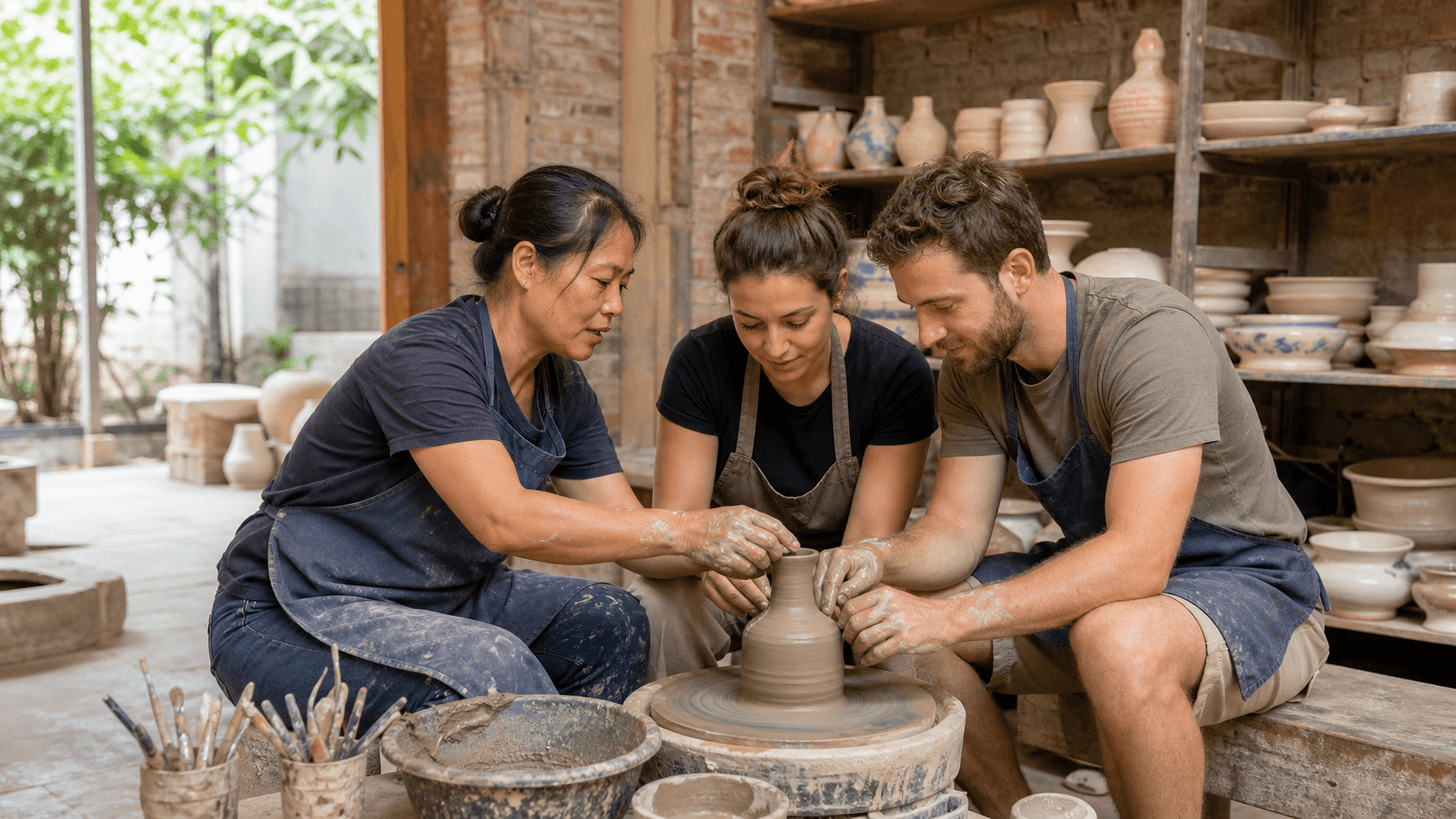
Pottery and ceramics
Wheel throwing, hand-building, decorating, or glazing may be separate activities. A piece often needs drying and firing after the visitor leaves.
Learn the process before making the souvenir
A thoughtful workshop can connect an object to its material, maker, place, and purpose. Compare who teaches, what guests actually do, how the fee works, and whether the finished piece fits the journey home.

The value lies in understanding process—not producing a flawless object quickly.
Vietnam Tourism describes craft villages as places where specialized skills are passed through generations. Its official craft-village overview introduces pottery, weaving, silverwork, drums, and other traditions.
A visitor workshop may adapt a complex craft into a short lesson. That can still be worthwhile when the adaptation is explained honestly, the teacher is respected, and guests understand which stages normally take longer.

Materials change the learning, safety, timing, and packing plan.
Wheel throwing, hand-building, decorating, or glazing may be separate activities. A piece often needs drying and firing after the visitor leaves.
A workshop may involve shaping a frame, attaching fabric, decorating, or assembling prepared parts.
Sessions can teach stitching, weaving, batik, indigo, or pattern meaning. Materials and community traditions vary.
Dó paper, folk printing, calligraphy, and bookmaking reveal different tools and histories.
A short visitor class may introduce decoration rather than the full multi-stage craft.
Work may involve knives, splinters, bending, repetitive hand movement, or pre-cut components.
Specific information matters more than broad ethical claims.
The provider should explain who teaches, their craft connection, and whether the session is artisan-led, guide-led, or demonstration-only.
A strong workshop explains the material, local use, technique, and meaning without claiming every object represents all Vietnamese culture.
Ask which steps are performed by guests and which require expert preparation, specialist tools, drying, firing, or finishing.
Confirm the full fee, inclusions, optional purchases, shipping, breakage policy, and whether buying additional products is voluntary.
Ask before photographing artisans, homes, private workspaces, children, techniques, designs, or finished pieces.
Check tools, ventilation, protective equipment, seating, steps, heat, dust, allergens, restroom access, and supervision.
Vietnam Tourism’s guide to Vietnamese crafts provides useful background on paper, lacquer, calligraphy, and ceramics. Treat it as inspiration, then verify the individual workshop.
Traditional practice can evolve while remaining meaningful to its community.
Do not treat every artisan as a performer or every workshop as a museum. Ask before entering private areas, touching tools, photographing people, copying designs, or posting detailed techniques.
When sharing the experience, name the craft, place, and maker as they prefer. Avoid presenting a short visitor exercise as mastery or describing one local practice as representative of all Vietnam.
UNESCO’s Vietnam intangible-heritage list shows why precise names, communities, and safeguarding context matter.
Build the workshop around learning and logistics, not compulsory shopping.
Select a pottery workshop near Hanoi because learning process and village context matter more than taking home a perfect object.
Confirm a small group, artisan-led instruction, wheel participation, duration, clothing, steps, restroom, firing, collection, and shipping terms.
Private pickup after breakfast; village orientation; workshop before lunch; buffer time for browsing without pressure to purchase; return before evening plans.
Assume the object cannot travel immediately. Choose studio shipping only after understanding price, timing, packaging, customs responsibility, and no-guarantee conditions.
Vietnam Tourism’s Bát Tràng day-trip guide offers destination context. Use the Hanoi guide to decide whether a craft-village day fits the rest of the city stay.
Drying, firing, curing, fragility, and customs can outlast the workshop.
The Vietnam souvenir guide provides broader advice on origin, packing, declarations, and responsible buying.
The right experience must fit both the traveler and the artisan’s working context.
VietnamTour.in can match a craft experience to a customized private route, arrange sensible transport, and communicate questions about the current teacher, participation, children, mobility, photography, materials, and finished-item logistics.
Share your interests, dates, pace, accessibility needs, and whether learning or taking home an object matters most through the trip-planning form. Ask for the workshop sequence and inclusions before confirmation.
Options include pottery, lantern making, embroidery, weaving, dyeing, paper, printmaking, calligraphy, lacquer, bamboo, wood, and other regional practices. Availability and visitor participation vary by destination and studio.
Avoid treating authenticity as a badge. Ask who teaches, where the technique comes from, which steps are traditional or adapted for visitors, how the studio relates to practitioners, and what the fee supports. Clear, specific answers are more useful than marketing labels.
Sometimes, but not always. Pottery may require drying and firing; lacquer, paint, dye, or glue may need curing; lanterns and woven objects may be fragile or bulky. Confirm collection, shipping, packing, and customs responsibility before starting.
Some are, with age-appropriate tools and close supervision. Ask about sharp tools, hot equipment, chemicals, dust, small parts, seating, session length, and whether an adult must work alongside the child.
Ask first, accept refusal, avoid interrupting skilled or hazardous steps, and clarify whether designs or techniques may be photographed. Permission to enter a workshop is not automatic permission to photograph every person or object.
VietnamTour.in can match a workshop to the route, traveler interests, pace, accessibility, and private transport needs while communicating practical questions in advance. Travelers should reconfirm the current teacher, process, inclusions, and finished-item arrangements.
Choose a named teacher, understand the cultural and material context, participate honestly, ask before photographing, and plan the object’s journey home before making it.
Add a Craft Workshop to Your Private Vietnam Tour