
Town and heritage ride
Shorter distances and frequent stops can suit casual riders, but junctions, pedestrians, parked vehicles, and mixed traffic still require confidence.
Match the route to the rider—not the brochure photograph
A good bicycle experience starts with honest ability, a specific route, a correctly fitted bike, clear support, suitable conditions, and permission to stop.
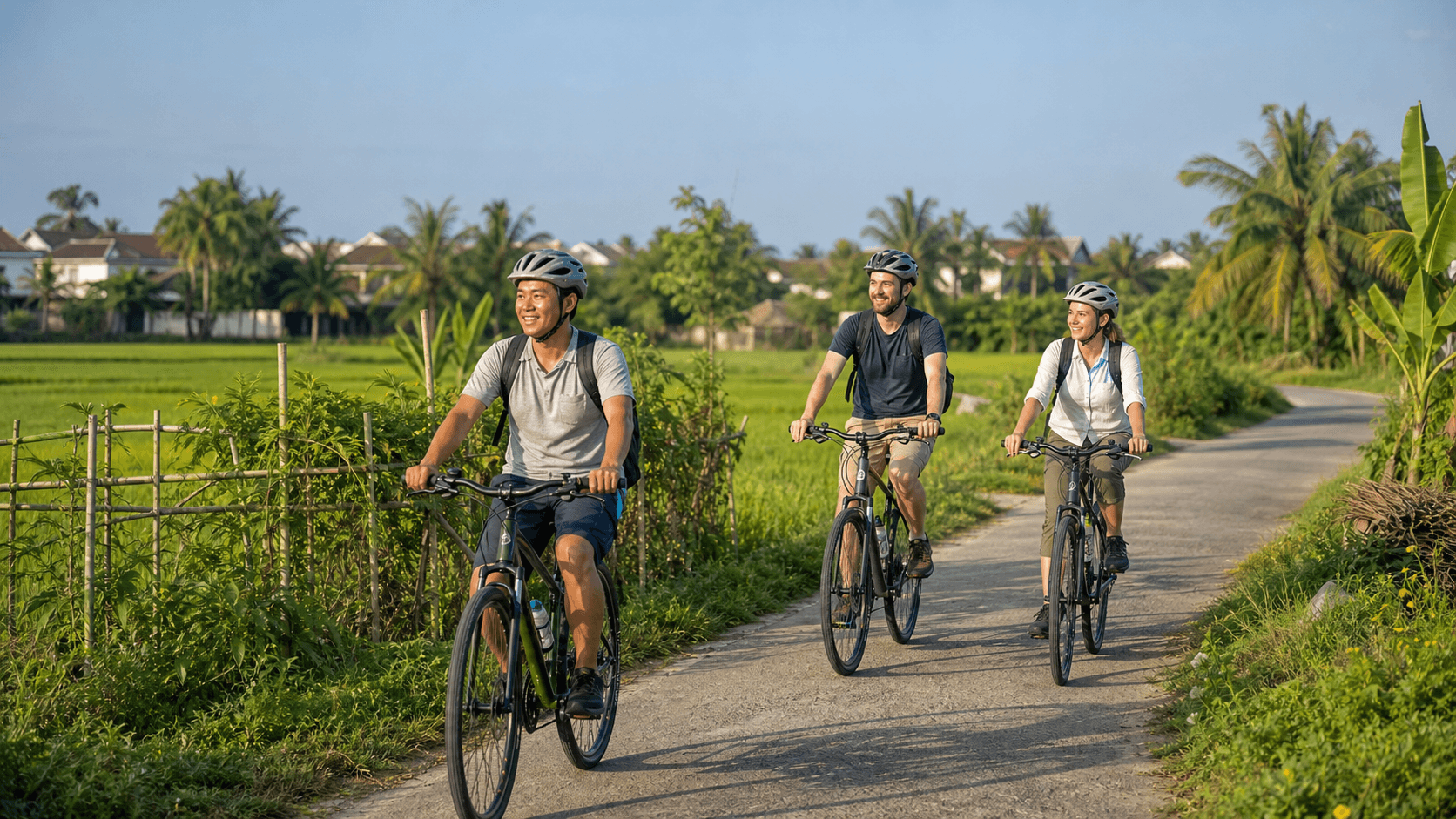
“Cycling in Vietnam” covers very different experiences.
Vietnam Tourism’s official transport overview highlights guided bicycle tours in central Vietnam and the Mekong Delta, as well as cycling in towns such as Hoi An and Hue. It is inspiration, not a route-specific safety assessment.
A peaceful photograph cannot show every junction, bridge, loose surface, animal, weather change, or vehicle interaction. Ask for the actual route and support plan before deciding whether the ride fits.
Difficulty is a combination, not a single distance.
Shorter distances and frequent stops can suit casual riders, but junctions, pedestrians, parked vehicles, and mixed traffic still require confidence.
Rice fields, villages, gardens, and quiet lanes can feel approachable. Check narrow bridges, unsealed sections, animals, local traffic, and shade.
Flat terrain does not always mean an easy route. Small paths, bridges, ferry or boat transfers, heat, rain, and limited vehicle access can change the experience.
Elevation, descents, surface, remoteness, weather, and rescue access demand suitable fitness, equipment, guide competence, and support.
Daily distance is only one measure. Repeated riding, luggage, recovery, bike fit, maintenance, accommodation, and non-riding transfers all matter.
Assistance can reduce effort but adds weight and unfamiliar controls. Confirm battery planning, handling, charging, minimum ability, and what happens after a fault.
Vietnam Tourism’s Mekong Delta guide describes cycling along small paths and bridges. Use details like these to ask concrete questions rather than assuming flat terrain is automatically simple.
A complete activity description should explain the ride and the response plan.
Do not surrender a passport as casual collateral. Ask for a documented alternative and keep identity documents secure. Review the Vietnam travel-insurance guide before choosing an activity.
Test the assigned bicycle, not the model shown online.
Stand-over clearance, saddle height, reach, handlebar comfort, and stable starts and stops should work before leaving the meeting point.
Know which lever controls which wheel. Test both gradually at walking speed and ask for correction if response feels weak, abrupt, or uneven.
Shift through the usable range under instruction. Learn how the selected bike behaves before reaching a hill or busy junction.
Look for appropriate pressure, secure wheels, sound spokes, tread suited to the route, and no visible damage.
Use the correct size, level position, and secure strap. Replace a damaged or poorly fitting helmet rather than accepting it for convenience.
Save the guide’s contact, understand regrouping signals, and know what to do after a puncture, fall, separation, illness, or sudden weather change.
Outdoor exertion changes the weather decision.
The CDC’s hot-climate guidance recommends suitable fluids, sun protection, lightweight clothing, cooler-hour activity, shade, and regular rest. It specifically identifies strenuous cycling in heat as a higher-risk situation, especially for travelers who are not acclimatized.
A short ride still needs a complete plan.
Two riders describe their recent cycling, comfort in traffic, heat tolerance, height, health needs, and preference for a quiet route. The operator provides a route profile and written inclusions.
The ride is reconfirmed against current conditions. The pair prepares closed shoes, sun protection, lightweight clothing, medication, water plan, and insurance details.
The guide checks bike fit, helmets, brakes, gears, hand signals, road positioning, regrouping, and the support plan before the countryside section begins.
The group uses planned shade and water stops. Nobody is pressured to match the strongest rider; the route is shortened if conditions or confidence deteriorate.
The afternoon stays free for food, shower, rest, and an optional local walk rather than another exposed physical activity.
The Hoi An destination guide can help pair the ride with nearby independent time instead of another distant excursion.
A village lane is not a closed tourist course.
A customized itinerary can protect fit, transfers, conditions, and recovery.
VietnamTour.in can place a guided bicycle experience in a suitable region, coordinate private transfers, ask for route and equipment details, and keep a non-riding alternative available. It can also avoid scheduling a demanding transfer or early start immediately after the ride.
Share every rider’s recent experience, height, traffic comfort, preferred surface, health or access requirements, children’s details, and interest in vehicle support through the trip-planning form. Use the local-guide decision guide to compare guided and independent time.
Some short guided countryside rides may suit beginners, while city traffic, narrow paths, bridges, hills, or remote routes may not. Ask for exact conditions and honestly describe current riding ability rather than relying on an ‘easy’ label.
A guide can add route knowledge, cultural context, navigation, equipment support, regrouping, and a response plan. Independent rental suits riders who can assess the bike, route, traffic, weather, navigation, insurance, and repairs themselves.
Use a properly fitting bicycle helmet regardless of how short or quiet the route appears. Confirm the operator supplies an appropriate undamaged size or bring your own suitable helmet.
Suitability depends on age, height, skill, traffic, surface, distance, heat, supervision, and the exact child seat, trailer, tandem, or bicycle. Obtain operator requirements and equipment details in writing; do not assume adult routes suit children.
Policies differ on ordinary cycling, mountain biking, competition, altitude, helmets, guides, destinations, and medical evacuation. Read the definitions and exclusions for the exact ride before booking.
VietnamTour.in can place a suitable guided ride inside a customized private itinerary, coordinate transfers and recovery time, and ask operators for route and support details. The traveler remains responsible for disclosing ability and confirming insurance and medical suitability.
Demand a specific route, test the actual bike, use a fitted helmet, respect climate and traffic, and keep a real option to shorten or stop.
Plan a Private Vietnam Cycling Experience