
Broth and stock
A vegetable noodle bowl can still begin with meat or seafood stock. Ask whether the complete broth is vegetarian rather than requesting only that visible meat be removed.
Explain the diet, verify the kitchen, and protect the travel day
Vietnam can be rewarding for vegetarian travelers, but a strict Jain meal needs more than finding vegetables on a menu. Use exact requests, confirm hidden ingredients, and design the itinerary so a suitable meal is never an afterthought.
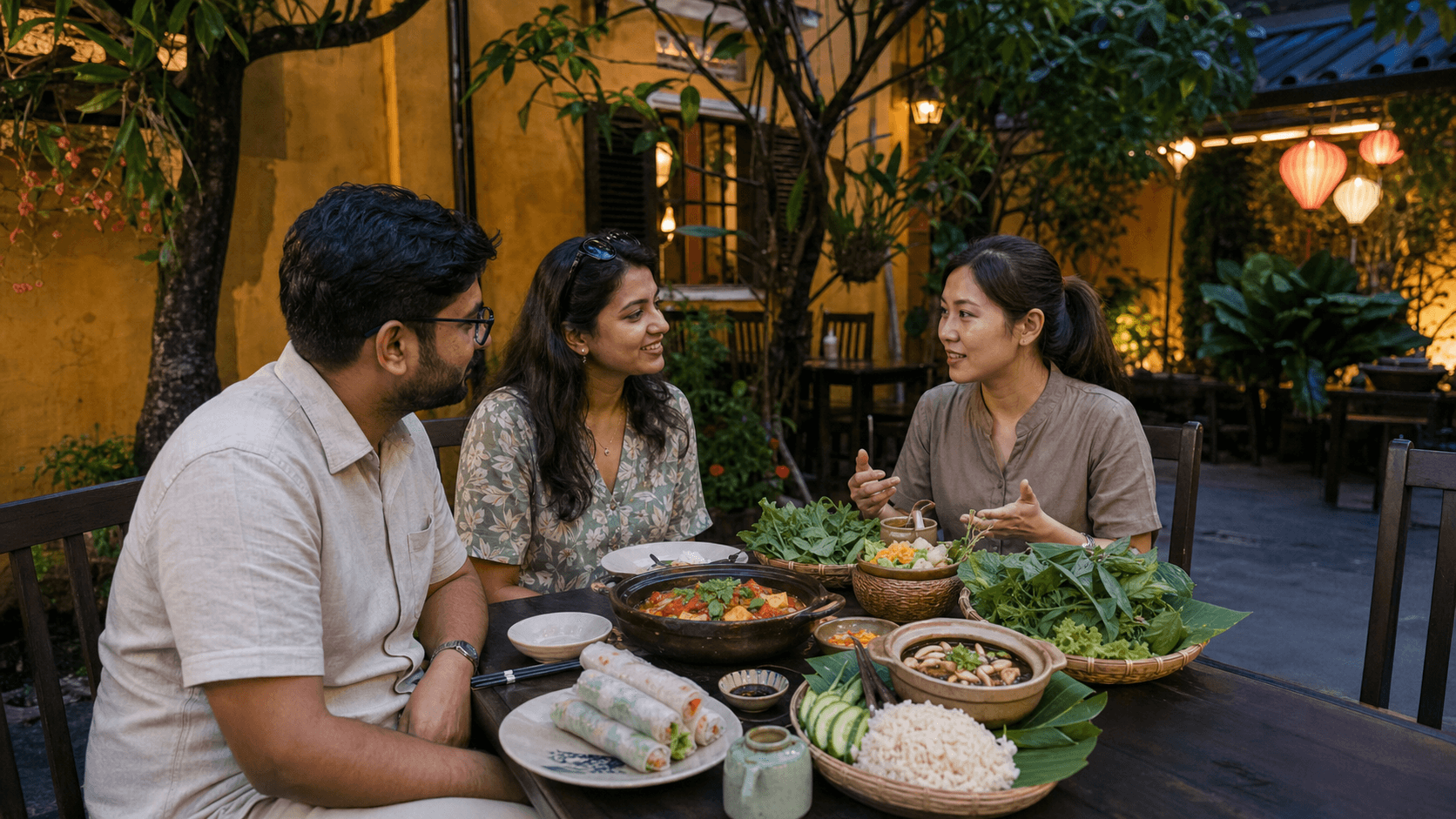
The planning problem is not finding vegetables. It is making the complete recipe match the way you eat.
Vietnam’s official tourism guide says vegetarian restaurants and meat-free versions of local dishes are available across the country. It recommends looking for “quán chay” or “cơm chay” and using “Tôi ăn chay” to say that you eat vegetarian food. It also specifically advises asking for no fish sauce. See the official vegetarian guide to Vietnam.
That is encouraging, but “vegetarian,” “vegan,” “no egg,” and “Jain” are not interchangeable. A strict request should define ingredients, kitchen separation, and any time-related practice that matters to you. A translated card supports the conversation; it does not replace confirmation by the cook.
What you cannot see is usually more important than the vegetables on top.
A vegetable noodle bowl can still begin with meat or seafood stock. Ask whether the complete broth is vegetarian rather than requesting only that visible meat be removed.
Sauces can be mixed into stir-fries, dressings, marinades, and dipping bowls. Request a vegetarian sauce and confirm that fish sauce and oyster sauce are not used.
Some travelers eat egg or dairy and others do not. State each restriction separately instead of assuming the word vegetarian communicates your version.
For Jain meals, name every ingredient you avoid. Ask about the sauce, seasoning paste, garnish, and pre-prepared base as well as the main vegetables.
A dish can be ingredient-compliant yet cooked in a wok, fryer, grill, or oil also used for meat or seafood. If separation matters, ask before ordering and accept that some kitchens cannot provide it.
Powders, soup bases, curry pastes, and bottled sauces may be difficult for staff to alter. A simple made-to-order dish with identifiable ingredients is often easier to verify.
Use short phrases to begin the conversation, then show the full ingredient list.
I eat vegetarian food.
A useful starting point, but follow it with your exact restrictions.
No meat.
Confirm seafood and sauces separately; this phrase alone is not a complete order.
No fish sauce.
Use for both the dish and any dipping sauce served alongside it.
No egg.
Important for vegan travelers and vegetarians who avoid egg.
No onion, no garlic.
A starting request for Jain travelers; a reviewed dietary card should list every other restriction.
Is this dish completely vegetarian?
Ask staff to check with the cook when the recipe is uncertain.
A short ingredient list often gives a strict traveler more confidence than a complicated menu adaptation.
At a vegetarian kitchen, ask about plain rice, tofu with tomato, steamed or stir-fried vegetables, mushroom dishes, vegetarian fresh rolls, and a clearly vegetarian noodle soup. Local versions such as pho chay, banh mi chay, or cao lau chay can provide a sense of place without treating your diet as an obstacle.
The official tourism guide lists vegetarian pho, banh mi, spring rolls, stir-fried noodles, tofu, eggplant, and mushroom dishes. These are ideas to investigate, not universal recipes: ingredients and preparation vary by venue.
A mixed buffet, pre-made soup, ready-marinated dish, shared fryer, or street stall with one wok may offer little control. Removing a topping does not change the stock or sauce already in the food.
When the answer is unclear, choose another dish or venue. A polite refusal from the kitchen is useful information, not a failed travel experience.
Cities provide choice; excursions and transfers require a firmer backup.
Hanoi
The capital offers vegetarian restaurants as well as meat-free versions of familiar noodle, rice, tofu, and vegetable dishes. Keep one researched lunch or dinner near the day’s sightseeing cluster.
Hue
Hue’s Buddhist food culture makes it a rewarding stop for vegetarian travelers. The Vietnam National Authority of Tourism highlights vegetarian versions of local dumplings and other regional dishes.
Hoi An and Da Nang
Hoi An has vegetarian versions of dishes such as cao lau and rice pancakes, while the wider Da Nang–Hoi An area gives travelers a useful mix of specialist venues, hotels, and international comfort food.
Ho Chi Minh City
A large dining scene gives you more choice, but menu labels and preparation still need verification. Save several options in different districts so traffic does not turn every meal into a long detour.
The Vietnam National Authority of Tourism describes Hue as a major Buddhist centre with a rich vegetarian food culture, including vegetarian versions of local dumplings. Read its feature on Hue’s vegetarian banh loc. For route context, compare the existing Hanoi, Hue, and Hoi An destination pages.
The itinerary protects difficult meal windows before choosing restaurants.
Day 1
Pre-confirm hotel breakfast; use a researched vegetarian restaurant for an early dinner after check-in.
Day 2
Carry a printed card; anchor lunch near the Old Quarter and keep packaged snacks for the afternoon.
Day 3
Ask the tour planner to confirm lunch in writing; carry a filling backup in case the group stop cannot meet the request.
Day 4
Eat before the airport if timing is tight; arrange a simple hotel meal for late arrival rather than searching after check-in.
Day 5
Choose a vegetarian local lunch; request Jain preparation separately and use a cooking class only after the ingredient list is agreed.
Day 6
Carry lunch or pre-book a suitable venue near the attraction; do not assume a buffet can avoid shared utensils.
Day 7
Use a confirmed breakfast and pack permitted travel snacks after checking current airline and security rules.
This scenario is a decision framework, not a restaurant list. It deliberately adds confirmation before remote sightseeing, airport transfers, and late arrivals. Use the regional packing guide to organise permitted snacks, refillable water, dietary cards, and any medical essentials.
Repeat the same checks until the correct plate arrives.
Send the dietary card and ask whether the kitchen can meet it at the planned date and time.
Ask a manager or server to confirm the request with the person preparing the food.
Confirm broth, sauces, seasoning, oil, egg, garnish, and every Jain restriction.
Discuss separate utensils, surfaces, cookware, and oil if those controls matter to you.
When food arrives, verify that it is the special order before tasting it.
If the process is uncertain, leave politely and use the planned alternative.
Clear, respectful questions work better than assumptions. The Vietnam cultural etiquette guide offers useful context for everyday interactions.
Good coordination reduces last-minute decisions without pretending any kitchen can guarantee every request.
A customized private tour can place meal time where it belongs: inside the itinerary. VietnamTour.in can share written dietary requirements with hotels and local guides, protect time for a suitable lunch, arrange a private transfer to an agreed venue, and avoid sending a strict traveler into a remote excursion without a backup.
Final ingredients and preparation remain the responsibility of the kitchen, and travelers should reconfirm each meal. The practical advantage is coordination: one route can account for sightseeing pace, family needs, flight timing, and dietary preferences together.
Major visitor destinations have vegetarian restaurants and meat-free versions of Vietnamese dishes. The official Vietnam Tourism guide recommends looking for “quán chay” or “cơm chay.” Availability alone does not remove the need to check broth, sauces, egg, and shared preparation.
No. Chay is a useful vegetarian or Buddhist-food cue, but it does not communicate Jain restrictions such as avoiding onion, garlic, or root vegetables. Explain the complete requirement with a carefully checked Vietnamese card.
You can ask, but not every kitchen can change a pre-made broth, sauce, paste, or shared cooking setup. Contact the venue before visiting, request a simple dish, and keep a backup when the staff cannot confirm the process.
Common possibilities include pho chay, banh mi chay, fresh vegetarian rolls, stir-fried noodles, tofu dishes, mushroom claypots, and vegetarian versions of regional pancakes or noodles. Verify the recipe each time because a dish name is not a guarantee.
A modest supply of familiar, permitted packaged snacks can help on flights, transfers, and excursions. Check current airline, security, and Vietnamese customs rules for the exact products before packing them.
VietnamTour.in can build meal time into a private itinerary, send written requirements to hotels and guides, cluster sightseeing near suitable options, and plan backups for travel days. Kitchens make the final preparation decision, so travelers should still reconfirm every meal.
Vietnam’s vegetarian food culture can be a highlight of the trip. Define your diet precisely, verify hidden ingredients, protect difficult travel days, and keep a realistic alternative.
Plan a Customized Private Vietnam TourPut this advice into context with Vietnamese food and culinary guide, Vietnam tour packages from India and Vietnam travel guide for Indian travellers. These resources help connect the article's practical guidance with the right route, travel style, and planning requirements.